Thursday, 20 September 2012

Reinventing the Wheel (Hoe)

I believe in short cuts. Some say that ‘you get what you pay for’. I prefer to find a good deal. For free if possible. I like to break laws such as the law of gravity. Bend the law of karma, produce vegetables and flowers with little effort, instead of by the sweat of thy brow.

Among gardening short cuts, there's none better than the wheel hoe. I first saw it in the book on Permaculture gardening by  Nikolay Kurdyumov, Growing Vegetables with a Smile and knew I had to have one. Next year we’re planting a 200 square meter patch of wildflowers, a cereal field and so on. My current approach to gardening of spading over the bed, weeding out buttercups one by one, rotavating, replacing lost soil with barrows of compost --- It's too much for one man. There has to be a better way.

Yesterday I cleared out the buttercup-infested wildflower bed. First I scythed down the weeds to two inches. Then the wheel hoe loosened the weeds and soil down to 4 inches. I raked the weeds up. A job that normally takes half a day was finished in an hour. Plus the well-worked top layer that is most fertile was preserved. Unlike the rotavator, the wheel hoe doesn't bury the weeds to where you can't find them.

Permaculture emphasizes working with the top 4 inches of soil. You mulch it with weeds, hay, straw, cardboard, leaves --- whatever decomposes. The soil’s fertility lies not in fertilizer but in the interconnecting pathways created by roots, earthworms and other bugs --- the soil’s structure. Destroy that by spading over the soil and no amount of fertilizer will help you.  I was sceptical whether Permaculture, shown to work in Australia and Russia, can work in Scotland with our heavy, slug-infested clay soils. But why not try it anyway and save a heap of work as a bonus. And so, this summer I mulched the veg beds with hay. I put away the spade and brought out the wheel hoe.

The beauty of the wheel hoe is  its efficiency in delivering your effort where it is needed. This is a result of the handle design and the wheel --- once again re-invented. In working a straight dutch hoe, you can’t deliver the necessary force because of your unwieldy grip on a straight handle. Also, the bit is driven into the ground rather than parallell to the ground. Trust me, it takes remarkably little effort to plough up your land with a wheel hoe.

Where do you find one? Such a simple tool, once a common feature in gardens, is unfortunately not readily available. In the US you can find one at Lehman’s, that sell Amish tools or at Valley Oak Tool Company,  all for about  $275. In the UK, your only option, other than the antique tool store or ebay is the Swiss made Glaser for about £330. All that money for a hoe?

Along with my philosophy of getting a good product, cheap, I opted for the Planet Whizbang hoe, and ordered it online. They sell you the metal hardware that makes up the hoe. You assemble it, find a suitable wheel and you make the handles yourself. The kit costs about $100, plus $45 if you want it shipped internationally. The design is excellent and durable. The hoe works like a miracle. Particularly important are the right-angle handle grips that deliver your effort efficiently, to push the hoe along. Amber has attacked the weeds in our gravel path with it. I've prepared and planted new beds, hoed out weeds in no time. Meanwhile my petrol rotavator is gathering dust in the garage. 


Give it a spin. See if the wheel hoe won’t transform your gardening too.


Wednesday, 1 August 2012

The Log Hive --- and its Residents


The past two weeks has seen a buzz of activity around the log hive. Bees coming in and out, flying in circles but appearing more frustrated than contented. Each day I poked my head into the log to see what was going on. Hundreds of them were packed into a giant ball suspended from the roof of the log. I didn’t see any sign of honeycomb building or any other activity. A couple buzzed in my direction to let me know that they didn’t care for me or my anxiety .

“Just go away and leave us alone. We’re managing,” they said.

Well might they be annoyed, as their entry into the hive wasn’t exactly natural. They arrived at Cottarton in a small nuc-hive, courtesy of the Moray Beekeepers, who supported my plans to keep bees in a hollow log where the bees can build their nest the way they do when left to themselves. The colony had an egg-laying queen, some drones and workers. They already had some brood cells (with embryonic bees)  and honey cells.

In Scotland as in many other countries bee colonies are in serious decline. There are few wild bee colonies left. The decline is blamed on certain new pesticides and the Varroa mite, a blood sucking parasite active in most hives. While I accept the causes, I also wonder if modern bee keeping methods don’t exacerbate the problem by providing an unnatural environment that makes bees more prone to disease and parasites. Also there's the current practice of harvesting honey and replacing it with sugar syrup. Isn't that like feeding the bees junk food? I was very impressed by the apiary of log hives in Cevennes,France. where, according to the local beekeeper, there has never been a Varroa problem. Neither are the bees fed sugar water. Could natural beekeeping help stem the bee population decline by producing healthier bees, able to deal with Varroa and other vicissitudes? Many bee keepers think so. There is a significant movement in many countries to redesign the hive to accommodate the bees natural way of building their nests.

I arrived at Cottarton with the bee colony. How does one move them into the log so that they will start building there? I built a horizontal platform on the log, connected it to the log with a plastic pipe. Set the hive onto the platform so that the only way out of the nuc would be through the log. Once the bees were out of space, wouldn't they move into the log? Well, after a couple of days I realized that they didn’t like their new front door. None of them showed up in the log.


Move-in day for the new residents


I moved them into the hive using the old fashioned way of shaking them off the frames into the hive. Then I set the hive back onto the platform and waited. They buzzed about like crazy but eventually settled down. This method of moving the bees proved unfortunate in that the bees left their brood cells in the nuc unattended. Brood need to be kept warm by the body heat of hundreds on bees, or they die. For whatever reason my bees didn’t find their way back to the brood cells and without their body heat, the brood appear to have died.

For several days the bees hung in a large ball, showing no interest in their old cells or the sugar water I left for them. I held my breath. They left the hive in ones and twos, flew about and returned. I couldn’t tell if they were feeding on anything. I called John Salt at the Moray Bee Dinosaurs. John also has a log hive plus years of experience with bees. In a steady voice, like a pediatrician talking to a nervous new mother, John suggested I calm down, leave the nuc out so that the bees can raid its honey.

I placed the nuc just outside the hive. That got their attention. They began to visit it, feed off the honey they had already stored there. Each warm day I would see more of them flying between the nuc and the log. The bee ball began to look active with bees moving about it. They were building something inside, but I couldn’t tell what. Also, they didn’t like me looking on because they’d shoo me off if I stared at them for too long.


Canterbury Bells


Outside the white clover was in blossom. On a hot day its delicious honey aroma wafted through the air. Canterbury Bells opened up. The garden began to buzz. When picking the Bells I would find so many bees feeding there that I felt guilty about stealing their food. While walking through the field I found more of them around the clover, busy but contented. Every warm day a cloud of them hovered around the hive entrance.

Finally I saw what they were building, white wax cells, several of them. Each day they added centimeters to their structures. Still no interest in sugar syrup. Why should they bother when they have good honey?


 They’d had a rough entrance into the hive, and a couple of weeks of adjustment --- but now they are at home. And they are happy.


Three days later

Tuesday, 24 July 2012

Gardener’s Day (a.k.a. Dachnik Day)


Yesterday many gardeners whose plots are producing their first vegetables celebrated Gardener’s Day. At Cottarton, several of us brought dishes made from vegetables we grew and mushrooms foraged from the woods. Flowers too. The table was laid with crab-apple wine and beer, dandelion wine, salads, chantrelles, fresh potatoes, sprouted beans. Despite a very cold April and May, with June and July temperatures resembling November’s, our Earth was still able to produce a festive bounty. The crowning blessing was the weather --- a balmy 20 degrees: the first such day for at least two months, brought on a strong southerly wind. And no rain. Am I too presumptuous to suppose that the Earth thanked us for the attention we gave her? Even the bees came out of their log and buzzed about us.

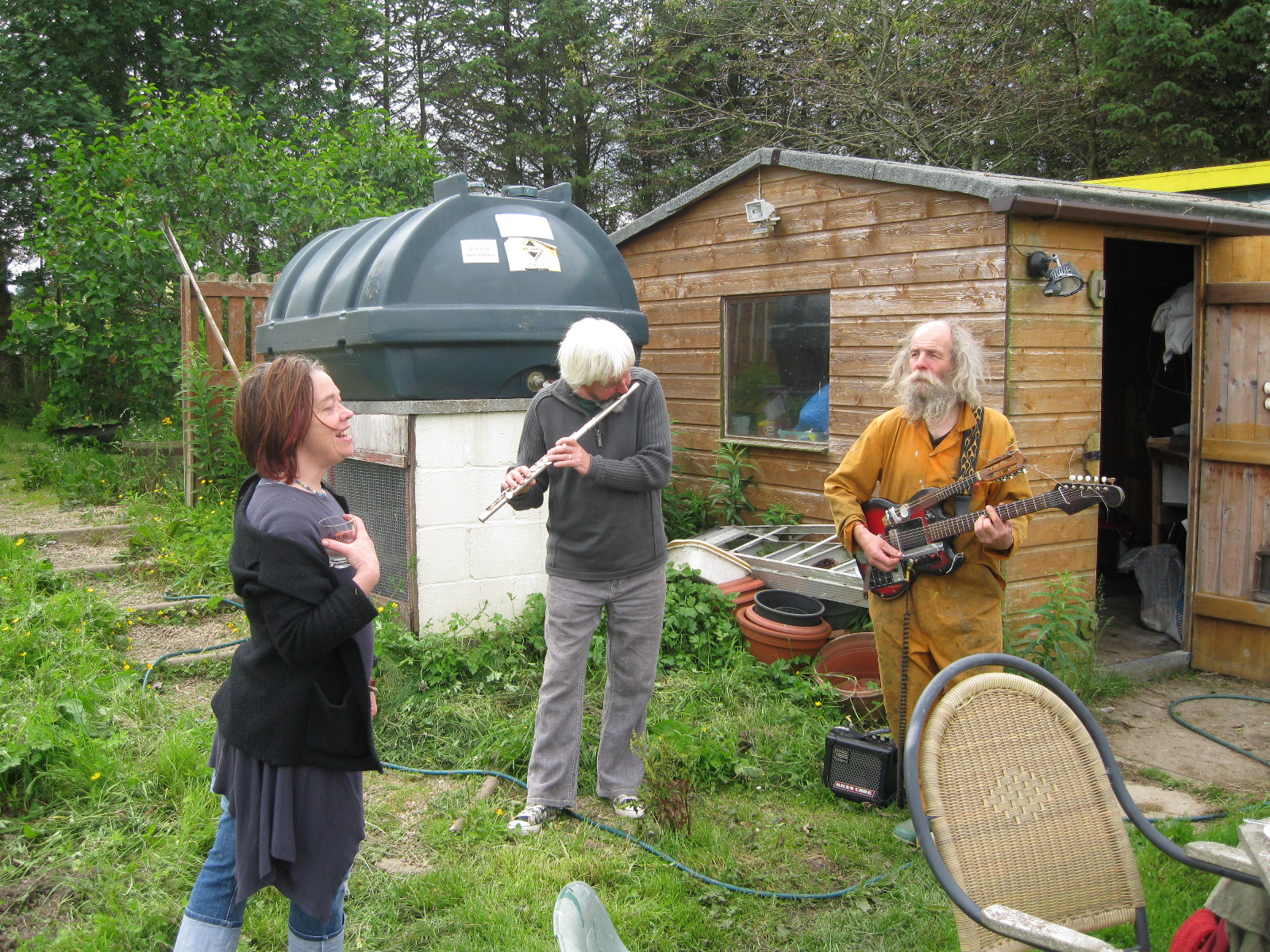
We raised our glasses to the Earth, and to Love whose power brings out the flowers and the fruits that energize us. Then the music began: Roy, Jake and Charles on their respective instruments and the rest of us singing. Magda brought each of us a sheaf of barleycorn, tied with coloured yarn, and led us in the song John Barleycorn a traditional harvest song. Maddie painted all our faces with whatever theme we asked for. When the guests left they took with them  garden produce and flowers from the table. Gardener’s Day, generally celebrated around July 23 is close to August 1 the medieval festival of the Gule of August, or Lamas. These days it doesn't make the Daily Mail headlines, but long ago it was a significant celebration of  the first harvests. As with most of our present day festivals, its origins lie with the Celts. August 1 was Lughnasadh, when the first corn was cut, and the first blueberries picked, corn rituals performed and marriages. Not only the harvests begin but the first mushrooms pop up --- but the Celts make no mention of those. It was a religious festival too. According to Monaghan’s  The Encyclopedia of Celtic Mythology and Folklore,

…a custom Lughnasadh shared with the other Gaelic festivals was the lighting of bonfires and visiting of holy wells. The ashes from Lughnasadh bonfires would be used to bless fields, cattle and people.[14] Visitors to holy wells would pray for health while walking sunwise around the well. They would then leave offerings; typically coins or clooties (see clootie well).[15]

It was not just an opportunity for food and booze but had a spiritual significance of reconnecting with the power of the Earth. In a curious way our day at Cottarton turned out that way too. Every now and then our guests would wander off to be alone for a while, down in the field and away from the bustle, to the walking labyrinth or to stand by the stream. Jake went off to pull sticky willow from our hawthorn hedge. The old spirit of Lughnasahd was alive.


In Russia they celebrate a Gardener’s Day whose date varies from region to region, but it began with Dachnik Day among the ecological communities. The Dacha is a small plot of land in the country with usually a rustic cabin. Dacha villages are found outside many cities and are where people raise vegetables on which they, “Dachniks”, subsist throughout the year. The celebration of Dachnik Day combines  feasting and song  with a conscious recognition of spirit that expresses itself through nature.


I find it curious how Dachnik Day, conceived only ten years ago, has since then spread throughout Russia and to many other other countries, without any particular promotion.  Certainly no commercial promotion. It appears to answer a psychological need in us. But for what? It's not only a date for a good party; you can have one any Friday night. Our psyche needs to feel a connectedness with our spiritual heritage in a deep way that isn’t tainted by old traditions and dogmas. To express our gratitude for the power that makes the corn grow and provides us with our daily bread.


Happy Gardener’s Day to everyone.

Thursday, 19 July 2012

Gateway to Paradise

Recently Amber looked over the back fence as the burn flowing at the foot of a steep bank, and noticed a little glade. We all thought about sitting there by the bubbling creek. The voice of the live water can bring inspiration, peace, and open even a door to another dimension. But how to navigate the steep and slippery incline down to the water? Here's the solution I came up with--- steps cut into the hill and framed with treated wood. It's a typical technique when building a mountain trail; heavy work but with Jehan's help we banged it out in a day.

 Jehan is here from France, working as a WWOOFer. Under this program,Worldwide Opportunities on Organic Farms, kids volunteer to work at organic farms throughout Europe for their room and board. It's a great way to see the world on a limited budget and learn organic gardening/farming techniques. Jehan has been in Scotland since May, on the Isle of Skye,Perthshire, and now at Cottarton. Click on this link for a walk up the hill to the gate. Turn up the volume for the sound of the water. The steps are muddy, but soon a news layer of grass will make walking easier. My nephew Juan Bleggi plans to replace our old Gateway to Paradise with one worthier of the name.

Tuesday, 10 July 2012

The Weather Report for Scotland


Last night after the local news,  instead of the familiar well-dressed weather-man standing by the map of Scotland and presenting the same dull weather, there was this wild-eyed chap in wellies, with long, white hair, a loose shirt, half-unbuttoned. When he spoke it was evident that he’d lost half his teeth. This is what he said, at least until a couple of men in black appeared and marched him off camera.

Good evening. In case you haven’t noticed it’s rather cold and rainy out there. Temperatures are holding around 12 degrees Celsius, a bit disappointing considering that this is mid-July, normally the hottest time of the year. (A toothless smile) Also, if you’ve been watching the earlier news you’ll have seen the floods in England and Wales, also very unusual for this time of year. (Long Pause) It’s been raining fairly constantly, with only short breaks since April. Gardeners take note: Earth is still barely warm enough to germinate seeds. Grains are growing slowly. Elsewhere around the world: record heat waves in the eastern United States along with a loss of lives. In southern Russia, the death toll from the floods is expected to be more than 150. (His stare was serious this time).

So, what is going on? They tell you that the Jet Stream is doing something or other. (A dismissive wave). Empty words. The truth is that the Earth is very sick, and that she has a high fever. She’s alternating between shivering and sweating. Over the past few hundred years she has been poisoned and she can't take it for much longer. To resist the toxins, she must withdraw from her normal activity and take care of herself. Wrapping herself in a blanket of clouds she’s lying in a dark corner away from the glare of sunlight. With little milk with which to feed her children, she must wait until she's better.

And now for the forecast. Well, to some extent that depends on you. When was the last time that you were sick, seriously sick, in hospital having to eat hospital food. Nurses bustled in and out, stuck you with needles. Took your blood pressure. Doctors strode in, wiseacred about what might be wrong with you, shrugged their shoulders, affected a smile. A bit like our politicians and weather scientists. What made a difference to your day? It was the people who visited you. The ones who brought you grapes, oranges or a book to read. They told you how much they missed you. The wife who talked to you, held your hand,stroked your hair,or the kids who kissed you and asked when you were coming home.  Just seeing them made you feel that you needed to get better. That you couldn’t just roll over and die. At least not yet. And maybe that’s when you decided to live. That too many people depended on you.

Ah yes, the actual forecast. You want to know whether it will rain during the Olympics. More importantly whether the nearby river will crest. I’m very sorry for those of you who have lost your homes and your livelihood. My house was flooded yesterday. While I sloshed through the water in my sitting room, trying to rescue my pictures, I thought of the land. She’s sick because we poisoned her. Even while she’s trying to shake her fever, we still pump her with toxins. And we expect her to heal? She loves us and misses our love. It's time to think about her welfare, make her feel appreciated so that she knows that people still love her. Don't dismiss her because she is sick. She wants us to touch her with our bare feet, to caress her, thank her for giving us a home and for feeding us. Tend her fruits and her plants. Grow close to her. Acre by acre  help her regain her health. She needs your help. Let her know that you appreciate the bounty that she freely bestows.

Do it and you'll see her smile.

Friday, 6 July 2012

The Kin Domain


When Amber and I moved to Cottarton people often asked, “Why are you moving to such a remote place?” “What are you doing there?” Truth to say, we weren’t sure, except that we  wanted to be closer to the land, partially supported by her bounty. So did our friends at Coldhome, though in addition, they decided to build their space from the foundation up. Next to our cottage stands a field: one grassy hectare that we’d no idea what to do with. For four years we developed a vegetable and flower garden --- but what next?


Recently I discovered that we’re part of a greater movement throughout Russia, Australia, the US and Europe, of families establishing themselves on a hectare of land with the vision of building a home for their children, and their children. A place that will provide food, energy, water and most importantly good physical and mental health through work with the land. In Russia such a smallholding is known as the family hearth, “Rodovoje Pomest’e”  or the Kin Domain. 

In the UK,  the movement of families to the land is slower because of high land prices and obstructive planning regulations, but it is growing. There are a few eco-villages --- communities of energy efficient houses made of natural materials. The Findhorn Community for example. Not all houses have enough land for self subsistence. The concept of a family home passed down through generations isn’t yet in the UK zeitgeist. Mobility of family members is taken for granted. Generations are often separated by large distances.

The concept of the Kin Domain was developed in Russia, following the publication of books by Vladimir Megre,  The Ringing Cedars. The books, presented as the teachings of Anastasia, a Siberian recluse, became best-sellers and inspired thousands of people to move closer to the land. Within five years of the books’ publication over 150 new eco-villages took shape. In Russia, the Kin Domain expands on the Dacha (country cottage), and is made possible by the high availability of empty land in central Russia; Siberian ghost towns waiting for people to revitalize them. See the reference article Ecofarming and Agroforestry for Self-Reliance for how micro-farming works in practice.


These days, the nuclear family is on shaky grounds, the family table disappearing fast, children are ferried rapidly from one activity to the next, food is grabbed on the fly. In the Kin Domain, families work together to build their space, promote a sense of cohesion, an appreciation for the land and how it works. Unrealistic, nostalgic, a step backwards or all of the above? Perhaps not. As our social fabric continues to disintegrate with crime, high unemployment, violence, mental and physical illness and the breakdown of the family, it seems to me that the prospect of people working together to build a healthy life has much to commend it. If it becomes a mass movement it could emerge as the force that turns the tide for the better. Green shoots of a new civilization.

 One can be cynical and assert that Kin Domain people will booze and fight each other just as much, as folk living in council flats. Isn’t alcoholism worse among country people? Haven’t we seen it before in the sixties with people moving onto the land and growing weed? This movement appears to have a different ideology. There’s less talk about getting high and having fun,  and a lot more  about what the Earth needs: an emphasis on clean living, hard work, a spiritual connection to the land, natural healing, home education of children and building a solid foundation for a family through a monogamous relationship. Each topic could be a separate blog.

Here's the plan of Cottarton.


We’ve already dug a pond and plan to plant 600 trees early next year. Within 20 years they’ll form a forest that will break our winds, provide homes for birds, squirrels, a wood supply to keep us warm, and building material.  Our present plague of slugs suggests to me that our ecology is out of balance. We need to restore it, increase biodiversity so that the land can not only support us but a wide variety of flora and fauna (deer excepted --- they’re NOT welcome). We'll also have herbs, perennial vegetables, and one or two cereal crops to support us. All for not an unreasonable amount of work?

To be continued…..

Thursday, 28 June 2012

The New Journey

A couple of days ago Mama embarked on the Journey. She’d been talking about it for a while, about the Train that she had to catch. But she hesitated for a long time on the platform. The idea of getting on board and leaving everything familiar behind must have been more than she could contemplate. Scary, because though you hold a ticket, you can’t read the destination that’s printed on it. Our material brain, wired for survival at all costs, fights the notion of embracing the unknown.


Rose, her sisters Tosia and Marynia 1928?

Children of Polish gentry in their daily garb


 Finally she opened the door and got on the train. In the preceding months, during her more lucid moments she talked more often about the coming journey.

 “Those are my things,” she said pointing to the chairs in the room, the photos on the wall, the dining table and the china plates hanging on the wall.

 “Yes,” I said.

 “I will not be taking them with me.

 “You won’t.”

 She looked at me steadily. “I won’t need them.”

 At another time she called me urgently to her side. She knew who I was.

 “Where is Theresa?”

 I told her that my elder sister was in Edinburgh. She’d be coming over in a few days.

 “And Munia?”

 “She’s in Ecuador.”

 “When is she coming?”

 “In mid July.”

 At that, Mama grew more agitated and said, “That’s far too late.”

 The conversation wasn’t a one off. She'd had it a few days earlier with Amber.

 Sometimes she opened the door of the train but then drew back. A month ago, dehydrated from not drinking enough she was admitted to hospital. She had a bad infection. The doctor felt that she only had days to live. We called Munia and asked her to fly over from Ecuador.

 I felt that Mama needed to be aware of what was going on. While she lay in the hospital bed, smiling at me, I said, “Mama, you are seriously ill. You’re dying.”

“No,” she said, emphatically, adding silently that I was talking nonsense. Imagining some rubbish.

 “You ARE dying,” I said.

 She gave me a wave of her hand to say, “Oh rubbish. There you go again, you silly."

 Did she know something the rest of us didn’t know?

 A few days later she staged, yet again, a miraculous recovery. Started eating and drinking. The doctors were left scratching their heads. She didn’t talk much after that, lay quietly looking at another world. Sometimes she’d return, smile at us, and even say something briefly.

 She always reacted to Father Jim MacManus who visited her when he was in town. She greeted him with the broadest of smiles and reached out to him. Her last words to him were, “I am very, very happy.”


Munia, Mama and the great grandchildren


 And so on Monday morning while Munia recited a few prayers to her, Mama took a last breath. She got onto the train. The door closed behind her. When Amber and I reached her house, we saw her lying on her bed, apparently asleep. A beautiful aura filled the room, a feeling of blessedness that did not appear to emanate from a human source. The oppressive atmosphere of fear and anxiety that had hung around her bed in previous weeks was gone. I sat beside her as before and drank in that benediction.