Monday, 20 December 2010

Here Comes the Cavalry


In the midst of our winter snows, blizzards, freezes, airport closures, broken down trains, a lack of road salt, yes the general travel paralysis, there’s one good story. No, it’s not news of a thaw. Forecasters say that there’s no end in sight to our current ice age. The good news is that two tankers have docked at Inverness and Aberdeen, carrying 2 million litres of home heating oil. Most rural Scottish homes have no other source of energy; they cook with oil, heat their homes and their bath water with it. Lately, supplies in many homes have been low, and oil deliveries unavailable.


Each house has a tank containing 1,200 litres or more. When the level drops to less than half, you call a supplier and they fill your tank, usually within a week Not these days. Two weeks ago Brogan Fuels gave me an estimated delivery day of mid to late January. Their stocks are down; demand is up since mid November when the first snows fell. We’re lucky. In addition to oil we have a wood burning stove to warm our house. Our neighbours offered to loan us some oil if we run empty. But many others don’t have those options and must cope in cold houses. Here are some stories.


Everyone blames the winter chaos on government policies. Complacency. After all if Canada and Russia can handle their winters why can’t we?

We can’t because we’re in the midst of a paradigm change. Climate shock. This is our second severe winter that’s worse than anyone remembers. For over fifty years we’ve had mild winters. Our culture evolved around them, allowing us commutes of 50 miles to work, and unrestricted travel in good or bad weather. Suddenly we find that no longer realistic. Last years severe winter did little to prepare us for this one, because no one really believed it was coming. We bought some extra road salt, but not enough. Employed more gritting crews, but not enough. Heating oil budgets were way off. Airports left with too few de-icers and snow blowers. Even if they had them, incoming planes couldn't have landed safely.

When climate change happened before, it didn’t happen gradually. It didn’t give societies time to adapt. The medieval warm period lasted 300 years and ended in 1309. That winter caught everyone unprepared; was so cold that the Thames froze over. The following winter was no better. Then came the disastrous summer of 1315, cold with constant rain. Trading with the continent was disrupted. Corn varieties adapted to a warmer climate no longer grew. There were widespread crop failures and famine, especially serious because England and Europe’s population more than tripled during the medieval warm period. No amount of preparation could have mitigated the disastrous effects.

Following Scotland’s recent paralysis, the transport minister Stewart Stevenson resigned. What will his successor do differently? He can decide that we’re in a mini ice age, buy up new fleets of gritting trucks. Go to Russia for lessons. Or he can shake his fist at the weather. Despite our technology, weather often has the last word.

Saturday, 18 December 2010

Father Frost


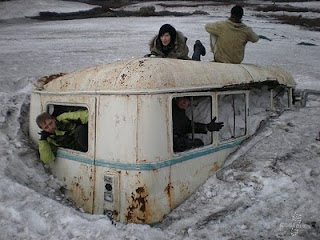
In an attempt to cheer us up, convince us that the typical Cottarton winter is not that bad after all, and to dissuade Amber and I from moving to southern France, our neighbour Anne Christie sent us these pictures from Russia. Father Frost is laying it on pretty thick there, but at least Russians have tractors and diggers when they need them, and don't have to rely on local councils for spreading grit. Their council taxes are also much lower than ours.


I guess I can fix the phone problem


The readiness of the dreaded Russian army


Here comes the plumber. Now where did you say you had a burst pipe?


Call this a highway?


Man, do I have to dig out this car?


Who left the car windows open?


Let's get this bus moving.


Let's count the strata. For how many years has this car been lost?


Does it blow this hard at Cottarton?

Tuesday, 14 December 2010

Blowin' in the Wind?


The lack of wind adds to the oddity of this winter. Winter --- yes it began this year not in December but in mid November when the first snows fell, like giants clouds, large flakes drifting down aimlessly. When it was over, I measured a constant 18 inches in our field. Usually we’re snowed in by gigantic drifts but not this time. The ski resorts opened and recouped their losses from several years back, but the renewable energy folk (those who cover our hills with clusters of steel giants with whirling hands) gritted their teeth. And not for the first time. Last year their production was down by at least 10%. From January to March while we waited under the snow, the wind giants stood still as sentinels. If this is the new pattern for our weather in the coming years, it doesn’t bode well for renewable energy, or our plans to derive our future energy from wind farms.

Usually it’s the gales and hurricanes, roofs blowing off, or flattening whole fields of barley that make a good story. Where’s the story in still air? It’s always windy in the northeast; we often stagger from the car to the door, bent double, while our shopping bag sails down the driveway behind us. Trees bend this way and that, their branches in an epileptic frenzy. I curse the spring wind that shrivels the seedlings that I've set out. I usually plant with an eye on the wind forecast. But when in November or January, the windy months, the air is breathless and the trees stand stupidly like they don’t know what to do, when the land feels like a tame puppy rather than a wolf, I know that something is amiss.

The pundits at the UK Met Office say that a long-term blocking high over Greenland has separated us recently from our Atlantic depressions, those that usually blow over us every three days bringing soggy but mild weather and a lot of wind. Now we’re getting cold air from Siberia. Father Frost from Russia has crossed over to Scotland and is now stalking our hills. He’s surrounded by snow clouds, has a bright red nose and piercing blue eyes. His hoary breath freezes rivers and lakes. The last time he came over was 200 years ago. From 1805-1820 Europe had very severe winters. In 1816, cold temperatures and excessive rain caused widespread famine. Ah Father Frost. In 1812 he came out to meet Napoleon’s troops, marching in their short sleeve shirts toward Moscow.

The pie chart, developed by 19th century statistician Charles Minard, tells the story of the appalling military disaster. The beige chart shows the French advance on Moscow, the black chart is their retreat. Line thickness indicates the size of the army. The red curve is the air temperature during the retreat. You can just see how the French army froze during their retreat.

The first wave of snow has gone.We're looking out at our green hills, and the sheep cropping the grass. But the air is suspiciously still. We're expecting Father Frost's return in a few days. It's time I chopped some more firewood.

Friday, 10 December 2010

Failed Service


The dreaded words come over the PA system while your train is stuck in the middle of a snow field. “Blah blah blah…This delay is due to a failed service ahead of us…” Translation, “Broken down train.” And so we wait; an opportunity to contemplate the meaning of life. That we’re all gathered in this tin can, all victims of “extreme weather.” Do any of us know each other? Know the same person? How might some of us be connected?

For once family members can no longer tell me…”But of course you have snow. What can you expect if you choose to live in Aberdeenshire. It’s so nice and sunny where we live. ”

The picture from on high tells a different story.

Despite the blizzards and freezing temperatures, I was determined to make this journey down the length of Britain. My daughters, Johanna and Natalia had recently moved to London. Natalia was singing in the chorus of Handel’s Messiah, something I didn’t want to miss. Amber volunteered to stay home, keep the house warm and feed the cats.

The train sits helplessly yet no one complains. Back in Texas, you’d see people pacing up and down, demanding to know who is in charge anyway. Scottish people are used to muddling along without being too vocal. Failed service is to be expected; actually no service is more common when temperatures dip below -10 Celcius (20 F) because the railway points freeze up. And so when I started the second leg of the journey south, I found no trains leaving Perth. I hopped on a bus headed for Edinburgh. The driver, a small chubby man enjoyed tormenting passengers shivering at the bus stop, telling them, “A’ve nae room. I’m a’ fu.” He waited till their faces dropped before waving them on board. We drove through a white landscape, so still you could hear your own thoughts. After crossing the Forth Bridge, a bridge similar in length and design to San Francisco’s Golden Gate, the bus started to make thumping noises. The driver pulled over; opened the door. A loud hissing coming from under the bus was not encouraging. He radioed for help, then turned to us and said. “Sorry, we’ve broken down.” (No euphemisms of a failed service).

“Ye can wait here for another bus or ye can get oot and walk.”

“Where’s the replacement bus coming from?” asked a passenger.

“Inverness.” He waited to take in the terrified faces before winking.

Actually we only waited for a minute before an Edinburgh local bus pulled in behind us and took pity on us. And so we limped into Edinburgh, where I boarded the London train. Because of subsequent failed services, the train rolled into Kings Cross four hours late.

On the train journey back to Scotland, my cousin Basia and I sat opposite two men who were involved in a conversation about music. I was astonished to hear the older man talk about a superlative performance of Handel’s Messiah he’d participated in.

“A performance in Spitalfields?” I asked during a lull in their conversation.


The older man was Bill Hunt, the violone player in Natalia’s concert. Johanna and I had noticed him, and wondered about his instrument, a cross between a cello and a double bass. What are the odds that out of twelve million Londoners you will find yourself sitting opposite a man who participated in the concert you just attended? Odds as small as winning the lottery. The concert had been extraordinary. The choir, known as the Nonsuch Singers, with the sharpness and discipline of a professional choir, produced an enchanting effect. Of the top-notch soloists, most interesting was David Allsopp, the countertenor. Countertenors produce a high voice similar to an alto, the same range as that of Baroque castrati. David sang the alto part in the Messiah. His high voice was so unexpected that it sounded supernatural. Small wonder that Baroque women used to swoon when a castrati sang.

And who was the second musician opposite us? He was a countertenor though not the same one as in our concert. There aren't many of them, but here was one. We talked for a while about how he produces the high singing voice, as his speaking voice is quite low. When you scream, you’re apparently using the same vocal technique that countertenors use.

The train slowed down then ground to a halt. Yes, another failed service near Newcastle was the problem. Here we were, five hundred people aboard a train. I’d met two connected by only one or two degrees of separation. How many others might there be among the others? Many more than one might expect.

Tuesday, 30 November 2010

The Hills, the Views and the Cats


The sun rising over the hill lights up the snowy landscape making it gleam like a mirror. I'm reminded of our last Christmas, a White Christmas and the last time that Mama was here at Cottarton. We were eleven around the Christmas Eve table; luckily the snow didn't keep anyone away. One morning, while she lay in her bed, she saw Cocia Renia (Cocia means Aunt in Polish), walk by on her way to the bathroom.
Mama asked , “Who’s that old woman I saw?”

“Cocia Renia.”

“Oh, then I must look old, like that.”

These days unfortunately we can no longer have such a fluent conversation. Her stroke has affected her ability to form words. But we do communicate. She's always overjoyed when Amber or I appear in the ward room. Amber introduces herself as, "Your best Presbyterian daughter in law." Mama always asks where we came from, as if we'd dropped from the moon. She'll say a word or two that I can make out; her eyes ask the question. Often she has to try a couple of tries before I understand.

“You’re asking where I live?”

She nods.

“Cottarton --- you’ve been there.”

Her eyes look puzzled; they ask me to explain.

“It’s the house in the hills, with the beautiful views and the cats.”

Her smile indicates that she’s made the connection. She asks again, trying to form a couple of words. At first I don't reply but she can tell from my look that I don’t understand. After a couple more attempts, I realize that she’s asking about Johanna and Natalia. Do I have any news from them? I begin by recapping that they live in London and about what they do for a living. Natalia has an upcoming concert of Handel’s Messiah. Johanna is enjoying her work at the British Library. She has a boyfriend. The girls call often to ask about their grandmother.

Mama smiles, a crooked smile where the right side is lower than the left but quite endearing. Her broadest smile is reserved for Natasha, when she runs into the room and flings her arms around her Cocia’s neck. The past five years Agata and her daughter, Natasha have lived with Mama and cared for her The three have grown close as blood family. Twice a day, at mealtimes, Agata is at the hospital. Yesterday she trudged for two hours through kneehigh snow to get there. She feeds Mama, spoon by spoon, a process that sometimes takes two hours. Mama must be reminded what to do with each bite. That it must be swallowed. The process doesn’t always work, and for Mama it's often exhausting. But it’s the only way to feed her.

That's on a good day. Last week when I was there, Mama slept the entire time, a deep comatose sleep that lasted 48 hours. But when I held her hand, her fingers tightened about mine. For two days she was out. Phones buzzed between Cottarton, Scone and Edinburgh. We waited. Wondered if her turn meant that she was in a terminal process. Then Mama woke up and asked for breakfast. She greeted Agata and Natasha with a smile, then asked what the fuss was all about. Can’t she go home yet? Why not? Her Consultant (the doctor who takes care of her) shakes his head, telling us he doesn’t know what to make of Mama’s condition. Her brain, shot through with Alzheimers has only limited regenerative ability to deal with the effects of the stroke. She may never speak as before, or be able to feed herself. But he admits that he doesn’t have a prognosis.

Mama has surprised us before. Like many women who lived through the war years in Poland, she emerged tough as nails. She’s not about to give up. Over the past couple of years she received the Last Rites at least ten times. Every time we think we’re about to lose her, she’s back, asking for breakfast.

A few days after her last stroke, I told her that Amber, presently in the States, was coming home early to be with her. Mama laughed. She mumbled out more clearly than usual: “Does she think I’m about to keel over?”

Saturday, 27 November 2010

The Day after Tomorrow


So, there’s this action movie playing in the neighborhood, where the Atlantic freezes over as a result of climate change, the Statue of Liberty is encased in ice, and Scotland disappears under a mountain of snow. Unfortunately the theatre where it’s playing, is our back yard. The first sprinkle was on November 22, then came Apocalypse Now . A dump like this, in November, hasn’t been seen for 20 years.


Just in case some of you try to accuse me of fraud, of using snow pictures from last year create a sensational blog that will make a lot of money, I'm including a picture of our garage. The green doors were painted last summer. So Amber and I are back in our snow routine. The car, with its snow tyres is parked at the end of our access road. The fridge is stocked. Anticipating this show, I planted long garden stakes to mark where to dig up carrots, leeks, turnips and parsnips. No more digging exploratory trenches to look for vegetables, thank you very much. I’ve also inserted a post in the garage to shore up the roof.

The weathermen point to their charts, incomprehensible except to the expert. They reckon that the Atlantic Jet Stream somehow lost its way, and doesn’t know where to find it. And so the frigid weather in Poland and Scandinavia has wandered over to the UK, to help find the lost Jet Stream. Actually, last April, Professor Lockwood, a climatologist at Reading University published a paper in which he warned us that this would happen. That it is linked with a period of very low sunspot activity. Here's the article.
Low solar activity link to cold UK winters
Climatologists have long recognized that the solar cycle affects our climate. Sceptics of man made global warming seized on this factoid like pit-bulls and won’t let it go, saying, "Our climate change is all the sun's doing, so tighten up folks and keep driving your cars." However solar variability cannot explain the Earth’s temperature --- still rising, or Greenland's melting glaciers. What Lockwood and others showed is that the solar cycle can explain changes in local weather patterns, such as the position of the Jet Stream. So, while Scotland shivers, the Spanish and Italians are baking. Even places in Greenland today have highs of 8 Celcius. Looks like the Scots drew the short straw of global warming effects.

Because of the sun’s role in our climate, I regularly check out solar activity. The website Spaceweather.com shows the latest pictures of sunspots, solar flares, and spectacular movies of the Northern Lights.Even comets. Lately solar activity is picking up and the sun is putting on a show for anyone who is looking. This also gives me hope that, if Lockwood is right, the coming winters won’t be as severe as last winter. But we may have to plough through one more.

As Mark Twain remarked, “Everyone talks about the weather but no one does anything about it.” So what next, now that the Day After Tomorrow is here?


We keep the house warm, the fire roaring in the fireplace and look out over our austere landscape. And we write, without the distraction of shopping or joy riding in the outer world. I like to take snow walks down our road. We rarely meet any vehicles. The white landscape contains an unearthly silence that belongs to another order than ours. Years ago on a business trip to Calgary, I tried to capture the sensation in this poem.

WHITENESS

Is not information.
Information is time, knowledge, the computer.
Our information age of
Where, what, why, how and when.
Words we value most.

But whiteness is the other.
It blinds your earthly eyes.
Buries under its cloak
All knowledge, information and memories.
And in its silence you discover
Earth and the deep sky’s ornament.
Certainty - and a vision of how things are.

Tuesday, 23 November 2010

A Scottish Thanksgiving


Thanksgiving: Messy, Complicated, Forgiving, Sentimental and Pecan Pie with loads of Whipped Cream.

While I celebrate my fifth year wedding anniversary in Scotland, Americans dish up turkey and dressing, sweet potato pie and green bean casserole. This is Thanksgiving week. A harvest festival: a week to be grateful for family and friends, football, Black Friday and Macy’s Thanksgiving Day Parade.

Even those who are less fortunate can queue up at the local shelter and enjoy a meal fit for a king. But in the average American kitchen this week, you can count on sheer pandemonium. Men and women who normally microwave their supper will wake before sunrise, to chop endless piles of onions and celery for cornbread stuffing, oyster stuffing, sage stuffing, chestnut stuffing; it depends on what part of the country you boast before happily getting on to the next project of more endless piles of chopping for yet another Thanksgiving favorite. Do you stuff the turkey, bag the turkey, baste the turkey, deep fry the turkey or simply order it from Central Market (if your roots are Houstonian)? There is much to organize on this popular American holiday, from how many pies to prepare to what time the feast is served to who will drive Aunt Jess and Uncle Nick home.

It’s not always easy being affluent. It has its shadow side, like loneliness and families who are fractured and so deeply wounded they must have two Thanksgiving feasts because of a history of pride and poor choices. (As is the case in my family: sadly, it's what we, the older generation, bequeathed to our children, my son, my nieces and nephews; it's their legacy).

I think it’s important to remember these ugly bits about the holidays because it gives such potency, such poetry to gratitude. Most of you reading this blog already know my family history and its unflattering tales and most of you will remember that in spite of this my mother and I and my son, Zach, actually managed some very pleasant, in fact memorable Thanksgiving moments together. Of course, on the other side of town were the rest of her family, her son and his wife and their children, her grandchildren celebrating without us; the shadow of Thanksgiving.

We simply gorge ourselves on this feast and even take another plate from the table to the den to watch football, when not far from this bounty, more food than is found in some small, under developed villages more than their population could consume in a week is the awareness that we eat and they eat less.

These are the polarities of life, the light and the dark, the old and the young, the sick and the healthy, the happy and the sad, the wounded and the new born of all our lives that bring us together in concert at Thanksgiving.


In the far northeast of Scotland last week, where the gale force winds hold you sideways and the sky casts a muted light, Adam, my nephew, came to visit. We didn’t celebrate a national holiday together, we just celebrated being with each other. We cooked and laughed and engaged in polite debate: the British way. Nothing escaped us, not religion, abortion, spirituality, psychology, the dying and the newly born, our immediate family members and their children and our respective trips back to the States, we covered much ground.

Adam and Paul played music to entertain the chef by and I must say we ate like Royalty, maybe better than. In this pre-Anniversary week, I was completely conscious of the goodness at the table here at Cottarton: the goodness of the people, their kindness and their generosity, the spirited conversations and the unreserved laughter – it was all here and yet…

I know what loneliness is: I know loneliness in a most intimate way and because I know, my gratitude for the family I do have and for the loving relationships active in my life, I am so very thankful this Thanksgiving season.

To paraphrase Joseph Campbell: “It doesn’t matter what seat I’m in at the opera, I’m just so grateful to see the show.”

At this American Thanksgiving Table, this season, don’t forget to pass a little shadow along with the cranberry sauce.